

A quantum leap for lead
A quantum leap for lead
by Lisa Allen
The latest microchip developed by computer giant Microsoft – Majorana 2 – has put lead centre stage in the race to take quantum computing mainstream.
According to Microsoft, the original Majorana superconductor used aluminium, but Majorana 2 uses lead because its unique qualities “help shield fragile qubits from cosmic disturbances that can make them unstable”. In other words, lead’s ability to shield fragile components from the impact of radiation or other interference – in this case, “cosmic disturbances” – is key to the significant improvements in the chip’s performance.
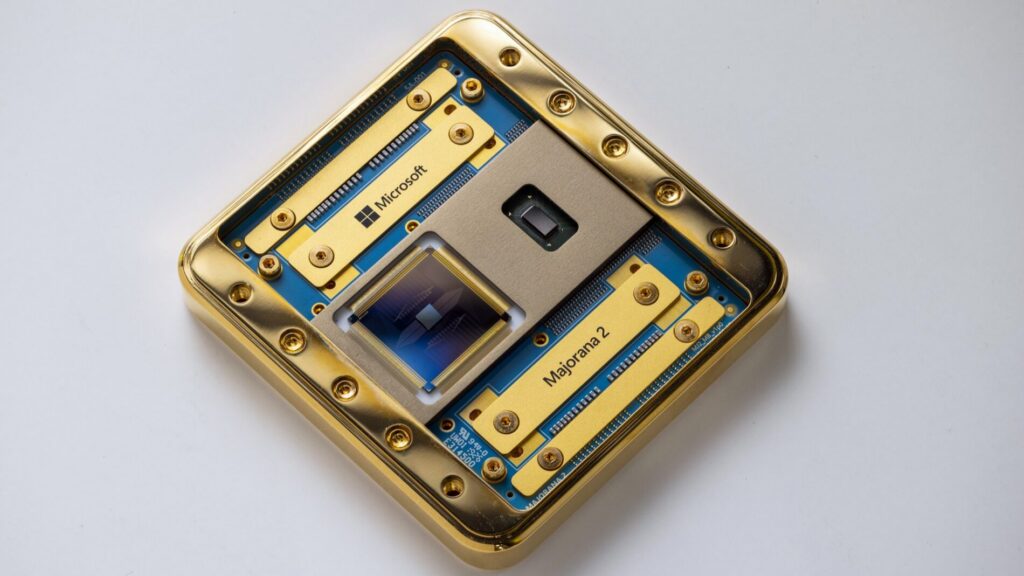
Microsoft Technical Fellow and Corporate Vice President of Quantum Hardware, Chetan Nayak, said: “That was actually a fairly large change, and it led to big, big improvements in device quality.”
The claim is that this microchip has qubits that are 1,000 times more reliable, enabling more dependable computing power. This extension of lifespans is due to the larger topological gap made possible by using lead.
Mr Nayak added: “We need to make improvements each year that will get us closer to delivering a computer that we believe will have massive commercial and societal value. We’ve got to keep marching to that roadmap to accomplish that, but where are we relative to last year? We’re 1,000 times better.”
Excited by this novel and innovative use of lead, and by Microsoft’s clear mention of lead’s key role, I contacted Mr Nayak directly to find out more. He told me ,”We carefully studied different superconducting materials and the performance of topological qubit devices incorporating them. We found that lead was superior according to several different metrics.”
Not limited to cutting-edge computing, lead also plays a vital role in radiation shielding in healthcare, nuclear facilities, border security settings such as airports, non-destructive testing (NDT) facilities, and specialist research environments that rely on atomic and high-energy lasers or sensitive detector shields. Due to its high density, as little as a few millimetres of lead can completely block the passage of harmful radiation. While potential alternatives exist, many present sustainability challenges such as greater environmental impacts or supply risk and consequent designation as a Critical Raw Material, while others are simply not feasible because of physical constraints. No other material offers the same combination of radiation-shielding performance and practical usability as lead. Lead is both a safe and sustainable material. It is fully enclosed in radiation-shielding fixtures and fittings, readily available in Europe, highly recyclable, and an ideal material in a circular economy.
The future of computing may be quantum, but one thing is already clear: when reliability matters at the cutting edge of innovation, lead remains a strategic material that no breakthrough can afford to overlook. Far from diminishing, lead’s role is becoming more important than ever.
